01
Royal Match · Dream Games
Product Analysis · 2026
The Abundance Gap
When everything is abundant, what is left to monetize?
Game EconomyMonetizationPlayer BehaviorExperiment Design
Executive summary
Non-paying accounts tracked
2
New account's coins from outside regular levels
61%
Main account's card collection
74/135
Across the two non-paying accounts I tracked, coins, lives and boosters rarely became binding constraints, while card collection remained the clearest persistent scarcity I observed, and one I could not directly accelerate with coins. Coins earned from levels were modest and flat (about 30 to 43 per normal level), yet balances kept growing. The first-purchase offers I observed mostly targeted coins, lives and boosters, resources that were not scarce for these accounts, while cards could not be bought with coins at all. The proposal below is a targeted, collection-linked first-purchase offer shown when a set reaches 8 of 9 cards, tested against a cheaper existing item before anything new gets built.
Context
Royal Match's economy, briefly
Royal Match (Dream Games) is a match-3 puzzle game whose revenue engine is a dense live-ops layer on top of short, move-limited levels. The core loop clears a level's goals within a fixed move count for coins and a star; the meta loop spends stars to restore rooms of a castle, opening chests of coins, boosters and card packs. A rotating set of time-limited events, 31 listed in the official Help Center at the time of writing, each reward a specific in-level behavior. Coins can only be spent on three things: extra moves, extra lives and boosters, both priced at 900 coins. Royal Match has led its genre in revenue for several years (Naavik deep dive).
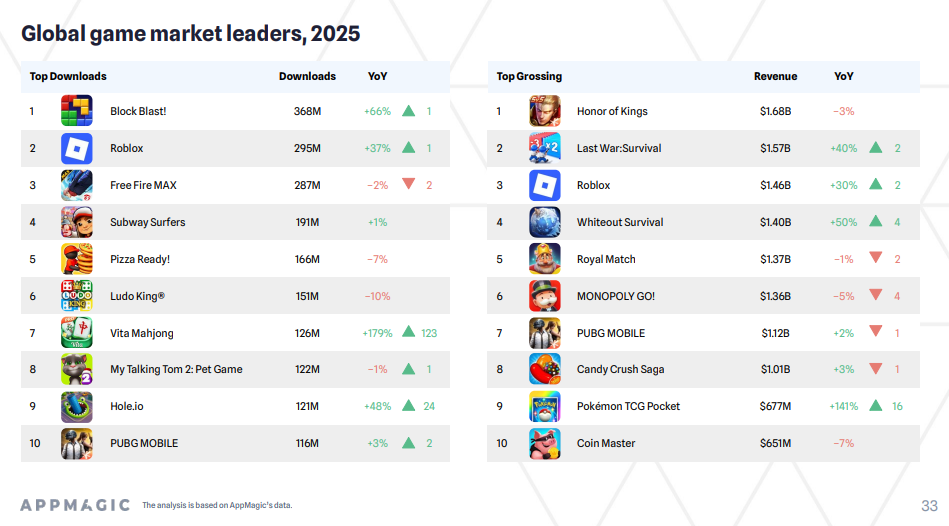
Source: AppMagic, Global Game Market Leaders 2025.
I played two accounts as a non-payer: a fresh account from level 1 to 60, and my main account around levels 165 to 175, logging every level's coin income, moves left, fail and continue decision, offer and card drop. I played naturally, spending coins when I normally would and logging the reason each time, so the data reflects real behavior rather than a test designed to confirm the hypothesis.
How to read this case
Three kinds of claim sit side by side here: what I logged directly from my own play (labeled own play logs), public data I did not generate (store reviews, AppMagic, Naavik, and similar sources, cited inline), and what I am proposing or assuming (hypothesis, proposal, and any figure marked illustrative). None of it is Dream Games' or Peak's internal data.
Question
Royal Match's generosity appears structurally intentional: rewards are repeatedly distributed through events, progression and social systems. If a segment of players rarely runs short on the resources a game's monetization is built around, where can a first purchase actually come from? This case looks for the resource that stayed scarce anyway.
Observations
Five findings
Resource supply · findings 1 and 2
1. Earned income is modest and flat
Regular level income stayed modest whether I was early or late in the game: about 30 to 43 coins per normal level.
Coins per level tracked moves left closely (correlation 0.89 across 50 normal levels): roughly 18 coins plus about 2.4 coins per remaining move, with higher bases on labelled hard levels and King's Nightmare levels. Average income per normal level stayed between about 30 and 43 coins from level 20 to level 175, so the 900-coin standard price equalled about 20 to 25 levels of play, early and late.
Coins earned per level rise with moves left
Fit on 50 normal levels: about 18 coins + 2.4 per move left (r = 0.89); rings mark 8 labelled hard levels
Illustrative replot based on the relationship observed in my own play logs (50 normal levels, r = 0.89); not the raw per-level dataset.
2. Abundance is distributed, not earned
Balances grew anyway, because most of that growth came from rewards outside regular play, not from playing levels.
From 2,000 at install to about 6,600 at level 60, and 13,960 at level 155, with zero purchases. On the new account, 61% of the 5,543 coins earned by level 60 came from outside regular levels.
Most coins came from outside regular levels
New account, levels 1 to 60: coins earned, starting gift excluded
Regular levels (1 to 60)2,156 coins
Bonus levels (20, 40, 60)1,239 coins
Room-completion chests1,000 coins
Book of Treasure650 coins
King's Nightmare298 coins
Haunted Pass (free track)100 coins
Instagram follow reward100 coins
Grey: earned by playing regular levels. Blue: distributed by the game. Own play logs, new account levels 1 to 60.
This pattern is consistent with a deliberate generosity strategy: distributed rewards reduce resource pressure and may support continued play, though that benefit cannot be verified without Dream Games' own retention data.
What actually became scarce · findings 3 to 5
3. Coins, lives and boosters did not become persistent constraints
Across both accounts, coins, lives and boosters never became a hard constraint on play.
The first entry into several events each day grants unlimited lives, and wins extend them by 15 to 30 minutes. Over the entire tracking period, across both accounts, I never ran out of lives completely. I failed 19 times across both accounts and continued only twice, about 10%, and both times the trigger appeared to be a visibly winnable board rather than event pressure or coin scarcity. Daily systems (Duke's Treats, Lightning Rush, Hidden Temple, Butler's Gift) supply boosters and unlimited-booster timers every day.
4. The offers I observed mostly targeted abundant resources
Yet every offer I saw was built around a resource I already had in surplus.
Four offers appeared on the new account between level 1 and 60. None converted me, and each reason traces back to the same gap: the resource for sale was not the one running short.
| Offer | Price | Headline value | Why it did not convert me |
|---|---|---|---|
| Haunted Pass | 499.99 TL | 8 lives instead of 5, golden frame and name, team gift | I never ran out of lives, even with 5 |
| Endless Treasure (paid step) | 149.99 TL | 3,000 coins, hammer, TNT | Shown when I already held about 3,000 coins |
| Royal Boost | 9,900 coins | 50 tokens doubling event rewards | One token burns per attempt, failures included; not worth saving 9,900 coins for |
| Continue / life refill | 900 coins | +5 moves or full lives | Equals 20 to 25 levels of income; bought only when a win was visible |
Offer
Haunted Pass
Price
499.99 TL
Headline value
8 lives instead of 5, golden frame and name, team gift
Why it did not convert me
I never ran out of lives, even with 5
Offer
Endless Treasure (paid step)
Price
149.99 TL
Headline value
3,000 coins, hammer, TNT
Why it did not convert me
Shown when I already held about 3,000 coins
Offer
Royal Boost
Price
9,900 coins
Headline value
50 tokens doubling event rewards
Why it did not convert me
One token burns per attempt, failures included; not worth saving 9,900 coins for
Offer
Continue / life refill
Price
900 coins
Headline value
+5 moves or full lives
Why it did not convert me
Equals 20 to 25 levels of income; bought only when a win was visible
Royal Boost shows Dream Games does run a large coin sink, but for my observed segment its perceived value was not high enough to create meaningful coin pressure, consistent with Dream's earlier, reportedly unsuccessful test of paying coins to multiply event rewards after a win (Naavik, 2025).
5. Collection cards were the clearest persistent scarcity
Card collection was the one goal coins could not buy, and the one that stayed incomplete.
Cards could not be bought with coins and did not drop from regular levels; they came from events, room chests, teammates and, for pass buyers, the Haunted Pass premium track. On the new account I earned 12 cards across 19 levels after the collection unlocked.
Main account's cards
74/135
Completed sets
0
Best set
8/9
On the main account, that was a move from 70/135 cards with 33 days left in the season to 74/135 with 30 days left: about one new card per day. If that pace continued unchanged, the account would end the season at roughly 100 to 105 of 135 cards, short of a full collection.
Dream already designs for this moment
The official collection page states the Red Pack guarantees at least one missing or 3+ star card and raises by 80% the chance of a card from sets one card away from completion; Purple Packs carry a pity timer reaching a 100% missing-card chance on the fifth consecutive pack without one. Gold cards start at a 5% draw probability. The 8/9 moment this case targets is one Dream's own design already treats as special.
Public complaints point the same way, with a clear selection bias toward frustrated players: one three-year player, two days before season end, reported still missing one final gold card despite saving stars and opening many chests, and said she could not make purchases (Şikayetvar, August 2025). A counterpoint: several complaints also describe levels becoming very hard and burning many lives, so resource abundance is not universal; it likely depends on difficulty and segment, which is why the proposal below stays scoped to event-active non-payers.
Opportunity
Do not make abundance scarcer. Test the constraint already present.
For the segment I observed, that constraint was collection progress.
One opportunity is not to reduce generosity, but to test monetization around the one scarcity that generosity does not resolve. Card progression was the clearest goal I observed that coins could not directly accelerate; an 8/9 set creates a visible, specific gap at exactly the moment I was most willing to spend; set rewards and a 10,000-coin grand prize sit behind the last few cards; and the collection season ends on a fixed date. Cards are already monetized broadly, through the pass track and a tested coin shop (Golden Offers). What I did not see was a targeted, deterministic completion offer at the moment a set reaches 8/9.
Hypothesis
A collection-completion offer will increase first-purchase conversion among non-paying, event-active players past level 40, relative to the offers they would otherwise see, without reducing engagement.
Proposal
The Wild Card offer
Offer non-paying players a low-priced "Wild Card" pack at the moment one of their sets reaches 8/9, letting them choose the exact missing card. The existing Red Pack already favours near-complete sets, so the test compares two items at the same moment: the new Wild Card (deterministic, needs new UI) and a Red Pack offer (probabilistic, uses an existing item). If the Red Pack converts nearly as well, it is the cheaper option to ship.
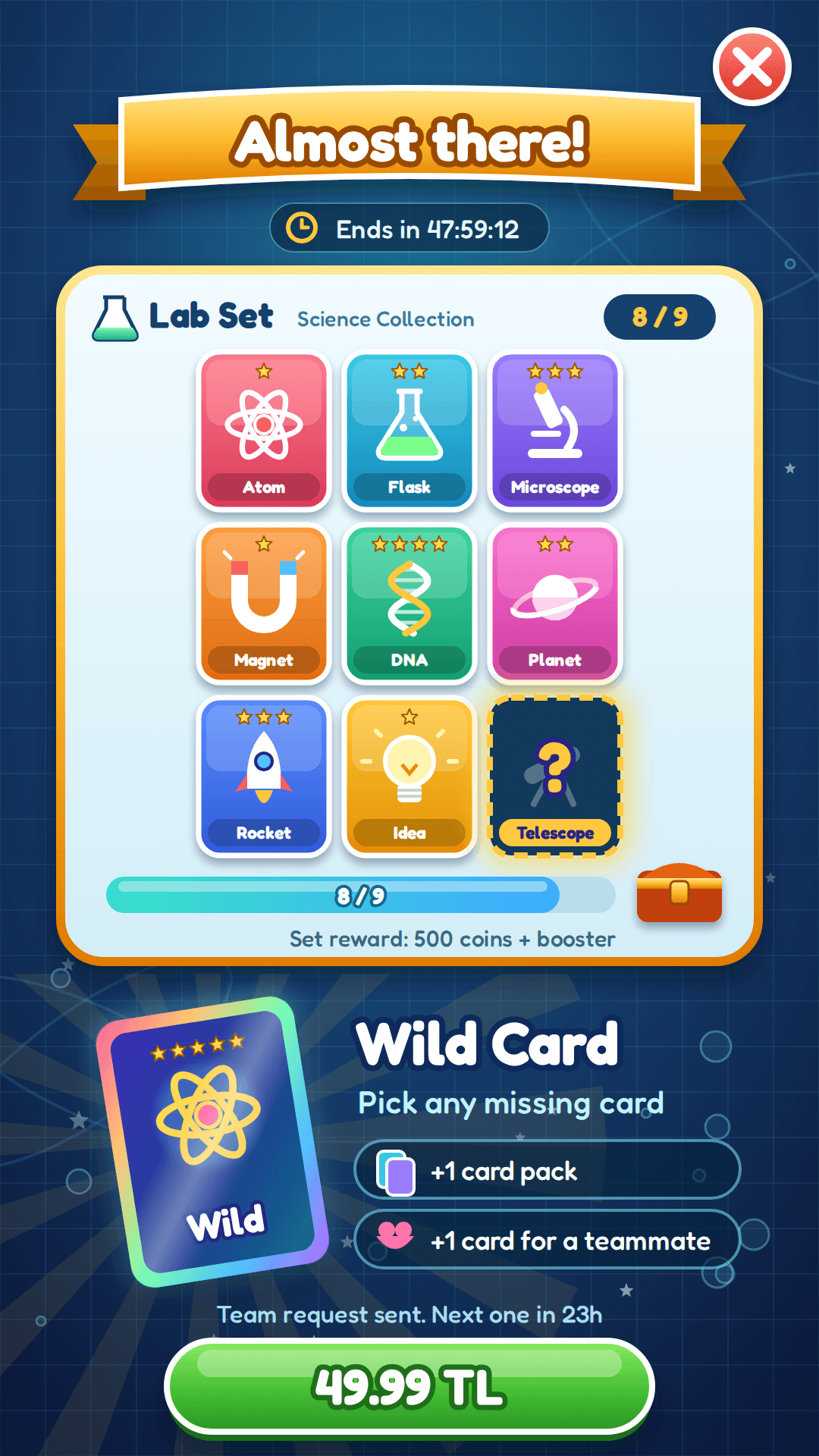
| Element | Design |
|---|---|
| Who sees it | Non-paying players with an active collection, level 40+ |
| Trigger | A set reaches 8/9 and the player has already used the day's card request, so the 24-hour request cooldown is running |
| Content | 1 Wild Card (player picks any missing card) + 1 regular card pack + 1 extra card to send to a teammate |
| Price | First-purchase tier, e.g. 49.99 TL vs 99.99 TL as experimental entry points; final range anchored to internal first-purchase pricing |
| Timer | 48 hours, once per set, at most one active offer at a time |
| Placement | Pop-up on the collection screen right after the 8th card lands, then a badge on the set |
Element
Who sees it
Design
Non-paying players with an active collection, level 40+
Element
Trigger
Design
A set reaches 8/9 and the player has already used the day's card request, so the 24-hour request cooldown is running
Element
Content
Design
1 Wild Card (player picks any missing card) + 1 regular card pack + 1 extra card to send to a teammate
Element
Price
Design
First-purchase tier, e.g. 49.99 TL vs 99.99 TL as experimental entry points; final range anchored to internal first-purchase pricing
Element
Timer
Design
48 hours, once per set, at most one active offer at a time
Element
Placement
Design
Pop-up on the collection screen right after the 8th card lands, then a badge on the set
Why it is designed this way
- Deterministic, not random: the player picks the card, which makes the value certain and avoids loot-box concerns.
- No coins in the bundle: coins were already in surplus on the accounts I tracked.
- Completes one set, not the collection: the grand prize stays earned through play.
What stays the same
- The free path remains intact: the 500-star duplicate chest still contains a Red Pack that favours missing cards.
- Team request stays the first step: the offer only appears after the day's card request is already used.
- Social bonus supports trading: the bonus card goes to a teammate, so a purchase feeds team trading instead of replacing it.
Experiment
How I would test it
Population: non-paying players, level 40+, with an active collection season, randomised at user level. Kept small on purpose, since non-payers past level 40 with a set at 8/9 are a narrow group: two arms plus control, run for one full collection season (about five weeks) so every group sees the same seasonal content.
| Group | What they see |
|---|---|
| Control | Current offers only |
| Test A | Wild Card offer at 8/9, 49.99 TL |
| Test B | Red Pack offer at 8/9, 49.99 TL (existing item, probabilistic) |
Group
Control
What they see
Current offers only
Group
Test A
What they see
Wild Card offer at 8/9, 49.99 TL
Group
Test B
What they see
Red Pack offer at 8/9, 49.99 TL (existing item, probabilistic)
Read-out: Test B against Test A shows whether a new deterministic item is needed at all, or whether the existing Red Pack, offered at the right moment, does most of the work.
Primary outcome
First-purchase conversion
Monetization guardrail
Revenue per user (ARPU)
Engagement guardrail
D7 / D30 retention
The full table below adds the secondary metrics and decision rules behind each of these.
| Metric | Why it matters | Decision rule |
|---|---|---|
| First-purchase conversion within the season | Primary outcome | Meaningful lift vs control; if Test B is close to Test A, ship the Red Pack offer |
| Sets completed per player | Shows whether the offer works through the collection | Directional read only |
| Second purchase within 30 days of the first | Shows whether new buyers keep paying | Monitored, not assumed to rise |
| D7 and D30 retention | Engagement guardrail | No material decline |
| Revenue per user (ARPU), all sources | Monetization guardrail | No material decline |
| Pass purchases | The pass premium track already sells card packs | No material decline |
| Purchases of other first-purchase offers | Cannibalisation check | Net ARPU decides, not offer revenue |
| Event participation and sessions per day | Engagement guardrail | No material decline |
| Card requests and sends per player | Social guardrail: the offer should complement team trading, not replace it | No material decline |
Metric
First-purchase conversion within the season
Why it matters
Primary outcome
Decision rule
Meaningful lift vs control; if Test B is close to Test A, ship the Red Pack offer
Metric
Sets completed per player
Why it matters
Shows whether the offer works through the collection
Decision rule
Directional read only
Metric
Second purchase within 30 days of the first
Why it matters
Shows whether new buyers keep paying
Decision rule
Monitored, not assumed to rise
Metric
D7 and D30 retention
Why it matters
Engagement guardrail
Decision rule
No material decline
Metric
Revenue per user (ARPU), all sources
Why it matters
Monetization guardrail
Decision rule
No material decline
Metric
Pass purchases
Why it matters
The pass premium track already sells card packs
Decision rule
No material decline
Metric
Purchases of other first-purchase offers
Why it matters
Cannibalisation check
Decision rule
Net ARPU decides, not offer revenue
Metric
Event participation and sessions per day
Why it matters
Engagement guardrail
Decision rule
No material decline
Metric
Card requests and sends per player
Why it matters
Social guardrail: the offer should complement team trading, not replace it
Decision rule
No material decline
Rough sizing, illustrative only, not a forecast: for every 100,000 eligible non-payers, if 40% reach 8/9 on a set and the offer adds 1 percentage point to first-purchase rate, that is about 400 extra first-time payers per season (roughly 20,000 TL in direct revenue at 49.99 TL). The value would sit in their later spending, which the second-purchase metric tracks; the internal queries below replace these assumptions.
What I would check with internal data
My observations come from one player, so four queries should confirm or reject the premise before anything gets built:
- 1.Coin balance distribution of non-payers by level band, and how often their balance falls below 900.
- 2.Share of event-active non-payers who end a season with at least one set stuck at 8/9.
- 3.First-purchase rate in the 48 hours after a set reaches 8/9, compared with other moments.
- 4.Share of card requests fulfilled within 24 hours, and how often the missing card is gold.
Falsification check
If query 2 shows few players stuck at 8/9, or query 3 shows no lift around that moment, the proposal should not be built.
Risks and limitations
Keeping the paid path narrow
The main risk is that directly selling completion progress could make the collection feel more pay-to-win. Every mitigation below keeps the paid path narrow and the free path open.
| Risk | Why it matters | Mitigation |
|---|---|---|
| Collection feels pay-to-win | Card trading and team help lose meaning if cards are bought | One card per offer, one offer per set; the existing Red Pack stays the free completion path |
| Team card trading weakens | Requesting cards gives teams a daily reason to interact | Offer only appears after the day's request is used; includes a bonus card for a teammate |
| Overlap with the pass | Pass buyers already receive card packs at several premium steps | Show only to never-paid players; track pass purchases as a guardrail |
| Cannibalisation | Buyers may switch from existing offers; a similar Dream test was reportedly dropped for cannibalising purchases | Restrict to never-paid players; measure total ARPU, not offer revenue |
| Event value drops | If sets complete faster, card rewards from events matter less late in the season | Cap at one active offer; watch event participation as a guardrail |
Risk
Collection feels pay-to-win
Why it matters
Card trading and team help lose meaning if cards are bought
Mitigation
One card per offer, one offer per set; the existing Red Pack stays the free completion path
Risk
Team card trading weakens
Why it matters
Requesting cards gives teams a daily reason to interact
Mitigation
Offer only appears after the day's request is used; includes a bonus card for a teammate
Risk
Overlap with the pass
Why it matters
Pass buyers already receive card packs at several premium steps
Mitigation
Show only to never-paid players; track pass purchases as a guardrail
Risk
Cannibalisation
Why it matters
Buyers may switch from existing offers; a similar Dream test was reportedly dropped for cannibalising purchases
Mitigation
Restrict to never-paid players; measure total ARPU, not offer revenue
Risk
Event value drops
Why it matters
If sets complete faster, card rewards from events matter less late in the season
Mitigation
Cap at one active offer; watch event participation as a guardrail
Additional considerations
| Risk | Why it matters | Mitigation |
|---|---|---|
| Slow card supply may be intentional | The 24-hour request cooldown suggests pace is deliberately metered | A 7/9 trigger test follows once the item is chosen; a held-back late-season window is a fallback |
| Already tested | Dream has tested adjacent ideas (Golden Offers, reward multipliers) | Frame as a narrower test: one deterministic card, at 8/9, never-paid players only |
Risk
Slow card supply may be intentional
Why it matters
The 24-hour request cooldown suggests pace is deliberately metered
Mitigation
A 7/9 trigger test follows once the item is chosen; a held-back late-season window is a fallback
Risk
Already tested
Why it matters
Dream has tested adjacent ideas (Golden Offers, reward multipliers)
Mitigation
Frame as a narrower test: one deterministic card, at 8/9, never-paid players only
This is a one-player, two-account study; its job is to generate a testable hypothesis, not to prove one.
- Sample: one player, one segment (non-paying, event-active). Paying and lapsed players may see a different economy.
- Personalisation: Royal Match varies rewards and offers by player, version and country.
- Collection pace: the 100 to 105 card projection rests on a few days of data and assumes play rate stays constant.
- No internal data: retention, conversion and card-drop rates are estimated from play, not from Dream Games' data.
- Possible test variant: Dream reportedly runs about 60 A/B tests a year with some long-running holdout cohorts, so my accounts may sit in a test variant of the economy.
- Complaint data is self-selected: public complaints over-represent frustrated players, which shows that last-card friction exists, not how common it is.
Sources
- Royal Match Help Center: Events and Tournaments
- Royal Match Help Center: How can I obtain and use coins?
- Royal Match Help Center: Royal Pass
- Royal Match Help Center: Duke's Treats
- Naavik: Royal Match deep dive (2022)
- Naavik: Royal Match, Success Through Iteration (February 2025)
- Royal Match: collection card packs and drop odds (official, Turkish)
- Şikayetvar: missing final gold card complaint (August 2025)
- Own play logs: two accounts, levels 1 to 60 and 165 to 175, with screenshots
Accessed October 2026. Offers and rewards in Royal Match can vary by player, version and country.